

Electric Field
Before discussing what is an electric field, let’s look to the Earth’s gravitational field for general answers about fields.
Gravitational Field
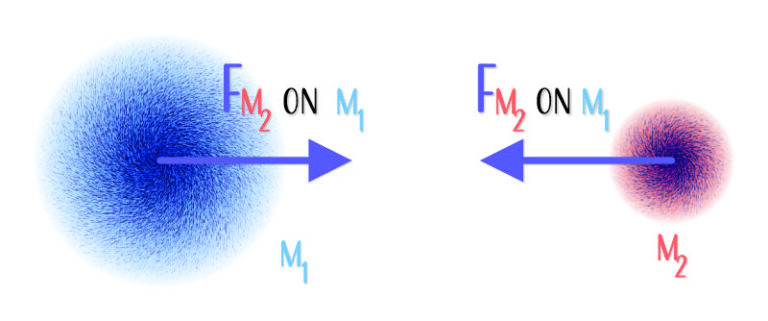
When we think of gravity, we tend to think of common objects falling towards Earth’s surface. But that is only half of an interaction. We do not tend to think about the Earth’s attraction to everyday objects because the Earth’s acceleration towards that object is imperceptibly small.
And we certainly don’t think about everyday objects exerting a gravitational force on one another, and that is because the gravitational interaction is so weak we have personally never witnessed it. Outside of carefully-designed experiments, you generally need an astronomically-sized object to generate the forces required to observe an interaction.
Do the Math
Use the gravitational mass of two objects, the constant of proportionality G, and the distance between the objects’ centers of mass, we can find the gravitational force of attraction between the objects. To do the math properly, we should consider the mass and exact location of every oil and mineral deposit, every rock, every wave, every person, and every other object in the Earth and on the surface. But that is too much work, so we assume a homogenous sphere.
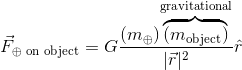





All humans near the surface of the Earth, from miners below the surface to pilots in commercial airplanes experience this same acceleration towards the center of the Earth. It is far easier to work with g=9.8(m/s2) than to go through this derivation every time you want to determine the acceleration of a new object. Since the mass of the object always cancels out of the equation, the acceleration will always be around g=9.8(m/s2).
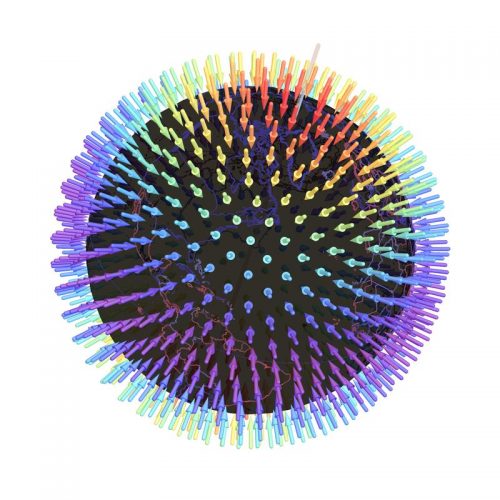
The Earth is not homogeneous, and it’s not a sphere. It is an ellipsoid with mountains and valleys, oil and mineral deposits, oceans, and all sorts of unique features. The gravitational field surrounding the Earth is non-uniform.
Suppose you dropped an object at 800 equally spaced locations around the globe and drew an arrow at that location to indicate the direction of acceleration. In that case, you might end up with the image below.
Vector Fields
If the length of the arrow is proportional to the magnitude of acceleration, the arrow becomes a vector. Mathematically, the collection of vectors is a vector field, and a value is defined everywhere in the region, not just the locations defined by arrows.
Fields are mathematical constructs that show how an object’s properties change in a two or three-dimensional region.
Since the vector-field we used in our example is due to gravity, another name for the collection of arrows is a gravitational field.
What is Electric Charge?
Electric charge is one property of matter that affects an object’s behavior during interactions with other objects. Particles that have a non-zero charge will interact with other particles with a non-zero charge in measurable and predictable ways.
The property of charge originates at the sub-atomic level with the proton and electron. As far as any experiments have ever shown, protons and electrons have exactly the same magnitude of charge. However, they do have a distinguishing attribute we describe mathematically with plus and minus signs. Charge magnitude comes in values that are always integer multiples of 1.6 x 10⁻¹⁹ C. The rules of the universe require that identically signed charges repel and oppositely signed charges attract. We don’t necessarily know why they behave this way – we’ve just observed it and then created a mathematical model that fits the behavior.
For mathematical convenience, protons are defined to possess a positive charge p = +1.6 x 10⁻¹⁹ C and electrons are defined to possess a negative charge[2] e– = –1.6 x 10⁻¹⁹ C.
Inertia and Forces
The rules of the universe also require that all objects move with constant velocity (straight lines at a constant speed.) The only way to change the velocity (speed and/or direction) of an object is through interaction with another object.
Electric Force and Coulomb’s Law
One such interaction is the electric force.
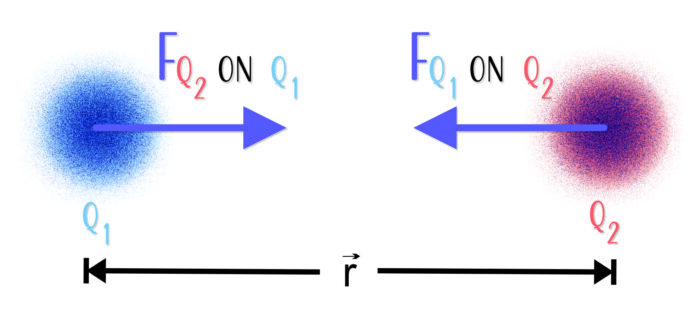
The magnitude of the force between any two point charges is proportional to the product of the particles’ electric charge q and inversely proportional to the square of the distance between the particles →r. Charge comes in multiples of 1.6 x 10⁻¹⁹ C and is carried on protons and electrons[3]. The direction of force lies along a straight line r that joins the two objects.
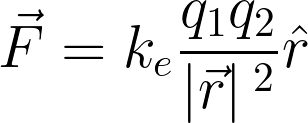
The constant of proportionality is:

The equation is known as Coulomb’s law. Every experiment performed has shown that Coulomb’s law is always true. We know that two charges will interact and experience a force in a direction along a line that joins the two points.
Three or More Charged Objects
By the time you investigate three charges, you usually have to keep track of the result of forces in two dimensions.
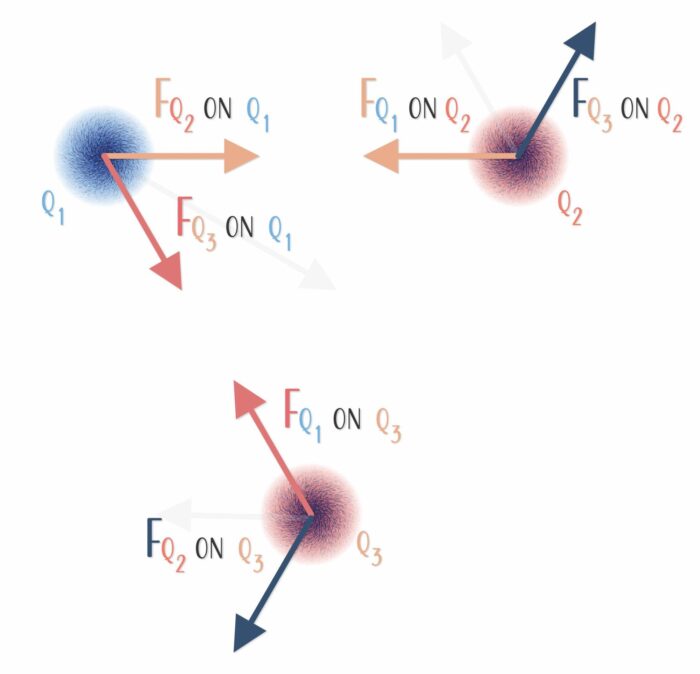
And with four charges comes the likelihood of keeping track of forces in three dimensions.
The Superposition Principle
Determining the effects of multiple charges is relatively simple. The resulting force is the vector sum of all the individual forces on a given charge. ΣF = F1 + F2 + … + Fn. Superposition in this context simply means that each interaction’s contribution is independent of all other interactions’ contributions.
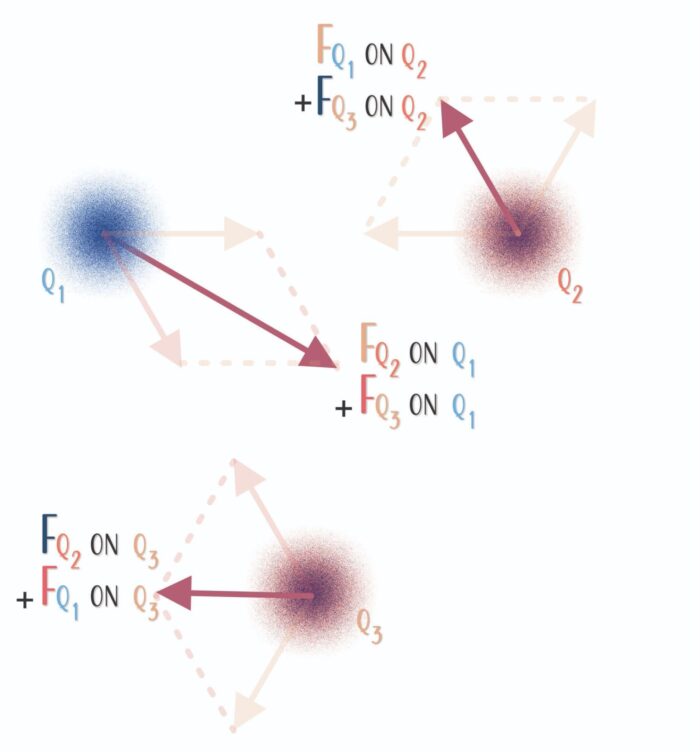
That might seem like a logistic nightmare because it is rare to find two point-charges alone in nature. Usually, where you find two charges, you’ll find several hundred thousand billion more within a centimeter radius. But do you even need to consider every charge in a centimeter radius? How about a micrometer radius? Or a nanometer radius?
Situations involving multiple charges can get complicated quickly.