

The combination solidifies Summit’s position as one of the largest privately owned printed circuit board (PCB) manufacturers in North America with a footprint that will now encompass eight manufacturing facilities. The acquisition significantly broadens the scope of Summit’s product offering while expanding the company’s business portfolio of key customers and end markets.
May 4, 2022 Anaheim, CA – Summit Interconnect is pleased to announce the acquisition of Royal Circuit Solutions with California operations in Hollister and Santa Ana and affiliate Advanced Assembly located in Aurora, Colorado. The acquisition expands Summit’s PCB offering in rigid, flex, rigid/flex and ATE PCBs, significantly strengthens engineering and service resources providing CAM, DFM/A, PCB design/layout, and also adds quick-turn, prototype SMT assembly services.
The combined company will provide best-in-industry use of software applications that integrate and automate engineering, stack ups, quoting, production management and customer interface. This highly developed platform will significantly improve speed and service to our valued customers.
Shane Whiteside, President and CEO of Summit Interconnect, Inc. stated, “This combination aligns the Royal and Advanced quick-turn, vertically integrated model with Summit’s differentiated production capabilities. Each entity brings capabilities to the Summit portfolio that will further strengthen our ability to serve our customers in both high-performance commercial and defense markets, as well as broaden our relationships into additional sectors. This is a very exciting milestone for Summit, Royal Circuits and Advanced Assembly and we welcome our new employees to the Summit team.”
Milan Shah, Owner and CEO of Royal Circuits commented, “We are very excited to align ourselves with the tremendous team at Summit and bring our automated software-powered approach to the Summit organization. Together, we will continue to build and scale a world-class company delivering technology solutions to solve the most complex printed circuit board challenges across all end markets.”
About Summit Interconnect: Summit Interconnect is a leading provider of complex printed circuit boards focused on fast growing defense and high-performance commercial sectors in the North American market. Summit offers solutions ranging from advanced cutting-edge prototyping to complex high mix, low-to-mid volume production. Summit’s facilities are located across California, Illinois, Colorado and Toronto, Canada. For more information, please visit: summit-pcb.com
About Royal Circuit Solutions: Established in 1998 and headquartered in Hollister, CA, Royal is one of North America’s leading providers of quick-turn, advanced technology prototype printed circuit boards. Royal provides customers across the industrial, medical, automotive, consumer, semiconductor, datacom and space markets with technology driven printed circuits in hours, not days. For more information, please visit: royalcircuits.com
About Advanced Assembly: For nearly twenty years, Advanced has helped engineers assemble PCBs in three days or less. Offering a full-range of manufacturing services for prototypes and low volume quantities. Advanced Assembly delivers at the speed of imagination. For more information, please visit: aapcb.com
Here is a fun post on PCB registration and Staying on Target!

Drill and layer to layer registration can be a complex and challenging goal in the manufacturing of a PCB. In my 37 years in the industry and my visits to over 100 worlds (PCB facilities). I have seen many wild approaches to registration, and found few fabricators that have truly mastered the complete registration process.
“Kid, I’ve flown from one side of this industry (galaxy) to the other, and I’ve seen a lot of strange stuff,”
PCB layer to layer and drill registration requires a deep understanding of literally all the moving parts. Material shrinks during lamination and it differs by thickness, resin type, glass construction and amount of lamination cycles. This is followed by drill operations, tooling methods and operator actions.
“The Registration Accuracy (Force) is what gives a fabricator (Jedi) his power. It’s the data collection (an energy field created by all living things). It surrounds us and penetrates us. It binds all of the drills, lands and layers (the galaxy) together.”

The following is a few light hearted Star Wars references to PCB registration. By no means is it a PCB fabricator tutorial on how to manage registration. This is just some fun on PCB registration and “Staying on target!”

LDI (Laser Direct Imaging) provides tremendous improvements for the processing of PCB layers. It improves the front to back registration of a core but it is still dependent on the correct core scaling that is needed for compensating lamination shrinkage.
Lamination and shrinkage.

“One thing for sure, we are going to be a lot thinner”.
During the lamination process the laminate material will shrink in size. An advanced PCB fabricator actually has retained shrinkage information for each resin system, core thickness, core constructions, prepreg and multiple lamination cycles. If your fabricator does not have this information or can’t explain how they manage it, well they might not be an advanced PCB fabricator.
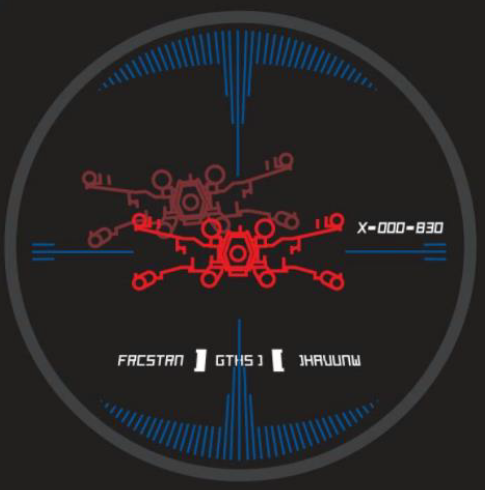
A fabricator that does not use the most advanced targeting and data collection methods is like Luke turning off his targeting computer. Did you ever notice that Darth Vader never turned off his targeting system? An image from Darth’s cockpit for objective evidence.
Turning off the targeting computer is like being Ty Webb from CaddyShack.

When we use all of our data, and effectively use our targeting systems and methods we are able to achieve excellent registration. If we don’t think and let things happen, we usually will end up with a mountain of scrap due to bad registration.
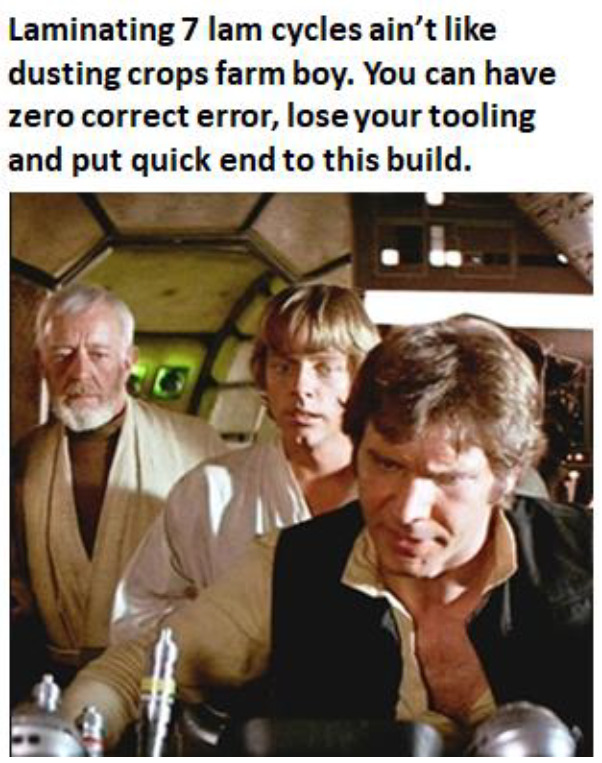
I can make fun of farm boys since I was once one.

Sometimes a design is asking for registration that can’t be achieved.
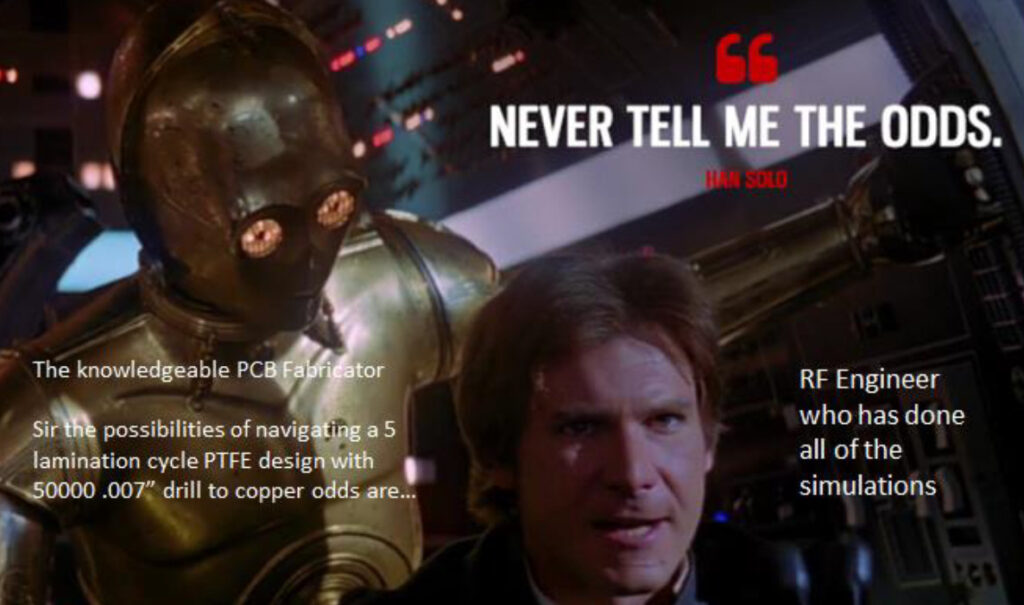
Sometimes it’s wiser for the fabricator to walk away from a bad design that can’t be registered.

If the design doesn’t follow IPC-2221, IPC-2222 or IPC-2223 guidelines your design, program, career or company could end up like this Tie Fighter. If a knowledgeable fabricator is concerned about registration, please listen to their advice.

When we do pull off a complex job and meet the registration, I would love to get the customer’s feedback on the job well done.

For the most part we are just like Chewy at the end of the original Movie at the award ceremony without a medal.

Maybe he was screaming out loud “where is my medal?” I don’t know, I don’t speak Wookie.
I hope you enjoyed the post. I was 13 years old when the first movie came out and I’m glad to see that it has entertained us all these years.
Well that’s it for now. I need to commence my bombing run on a high aspect ratio PCB with multiple lamination cycles, with a drill diameter that is too small, that wobbles, and an annular ring that should have been bigger, with no time to make a remake… “So let’s tighten up the formation, set your deflector shields to double front, and watch out for those Tie fighters. It will be just like Beggar’s Canyon back home”!
Special thanks to the following friends for their ideas on this post:
Mario Cortez
Daniel Heitner
Michael Lowry
Todd Maertz